Página 1 de 4
kendo
Publicado: 24 Ago 2003 14:06
por kenman
Hola a todos, veo que se habla de muchos estilos, pero hecho de menos uno, el kendo. ¿Alguien podría hablarme sobre este aa.mm.? No lo conozco apenas pero he leido hace poco una entrevista con un japones (no recuerdo el nombre) y me ha parecido interesante. Espero vuestras respuestas, gracias.
Publicado: 24 Ago 2003 16:38
por Einherjar
A ver si esto te ayuda:
Kendo literally means the way of the sword in Japanese. It refers to the art of traditional Japanese fencing that was originally developed and practiced by Bushi or Samurai. Kendo originated from the various sword fighting techniques of hundreds of years of combat and study. It deals with the physical and mental skills necessary for sword fighting. The goal of Kendo is not only to develop the physical capability for fighting but also the moral and spiritual aspects that may be applied in coping with real life. In Japan, it is one of the most popular martial arts. Kendo has spread to other parts of the world such as North America and Europe.
O esto otro:
Kendo, is the art of Japanese fencing. "Ken" or tsurugi is from the character meaning sword. The character for "Do" or michi includes the meaning way or path which translates as "The way of the sword". A path in life which is followed through the training of kendo.
Kendo, the Way of the Sword is the art of Japanese Samurai Swordsmanship. It is rooted in the traditions of Budo, the Martial Way. It is both exhilarating and demanding to learn.
In these pages we'd like to provide some information about Kendo and Kendo in the United States.
Origin of Kendo
Modern Kendo bears but faint resemblance to Kenjutsu and to its feudal origins of sword wielding samurai warriors which are today depicted in movies and television. Kendo, literally translated, "the way of the sword," cannot be traced to a single founder or given an exact founding date. The story of the rise of modern Kendo begins with the samurai and extends over the culture of several centuries.
By the end of the 12th century, the authority of the Japanese central government had declined. Bands of warriors grouped together for protection forming local aristocracies. Feudalism had come of age, and was to dominate Japan for several centuries. With the establishment of the Shogun in Kamakura and military rule controlling Japan, a new military class and their lifestyle called Bushido, "the way of the warrior," gained prominence. Bushido stressed the virtues of bravery, loyalty, honor, self discipline and stoical acceptance of death. Certainly, the influence of Bushido extended to modern Japanese society and Kendo was also to be greatly influenced by this thinking.
The Japanese warrior had no contempt for learning or the arts. Although Kenjutsu, "the art of swordsmanship," had been recorded since the 8th century, it gained new prominence and took on religious and cultural aspects as well. Sword making became a revered art. Zen and other sects of Buddhism developed and the samurai often devoted time to fine calligraphy or poetry.
The next great advance in the martial arts occurred during the late Muromachi period (1336-1568) often call the "age of Warring Provinces" because of the many internal conflicts. This period brought an increased demand and respect for men trained in the martial arts. Consequently, many schools of Kenjutsu arose, eventually numbering about 200. Each was taught by a famous swordsman whose techniques earned him honor in battle. Real blades or hardwood swords without protective equipment were used in training resulting in many injuries. These schools continued to flourish through the Tokugawa period (1600-1868), with the Ittoryu or "one sword school," having the greatest influence on modern Kendo.
Kendo began to take its modern appearance during the late 18th century with the introduction of protective equipment: the men, kote and do and the use of the bamboo sword, the shinai. The use of the shinai and protective armor made possible the full delivery of blows without injury. This forced the establishment of new regulations and practice formats which set the foundation of modern Kendo.
With the Meiji Restoration (1868) and Japan's entry into the modern world, Kendo suffered a great decline. The Samurai class was abolished and the wearing of swords in public outlawed. This decline was only temporary, however, interest in Kendo was revived first in 1887 when uprisings against the government showed the need for the training of police officers. Later the Sino-Japanese War (1894-95) and the Russo-Japanese War (1904-05) again encouraged an awareness of the martial spirit.
Consequently in 1895, the Butokukai, an organization devoted to the martial arts was established. In 1911, Kendo was officially introduced into the physical education curriculum of middle schools and in 1912, the Nihon Kendo Kata, a set of regulations for Kendo, was published. In 1939 as Japan prepared for war, Kendo became a required course for all boys.
After Would War II, because of its nationalistic and militaristic associations, Kendo was outlawed and the Butokukai was disbanded. However by 1952, supporters of Kendo successfully reintroduced a "pure sport" form of Kendo, called Shinai Kyogi which excluded the militaristic attitudes and some of the rougher aspects of practice characteristic of prewar Kendo, into the public schools. Today, Kendo continues to grow under the auspices of the All Japan Kendo Federation, the International Kendo Federation, and federations all over the world.
Although the outward appearance and some of the ideals have changed with the changing needs of the people, Kendo continues to build character, self-discipline and respect. Despite a sportlike atmosphere, Kendo remains steeped in tradition which must never be forgotten. For here lies the strength of Kendo which has carried it throughout history and will carry it far into the future.
Kendo Equipment
Kendo equipment consists of the swords, uniform and armor. There are two types of wooden swords used. First, the bokken or bokuto, a solid wood sword made of oak or another suitable hardwood. The bokken is used for basics and forms practice (kata). Second, the shinai, is made up of four bamboo staves and leather. The shinai is used for full contact sparring practice. The uniform or dogi consists of woven cotton top called a keikogi and pleated skirt-like trousers called a hakama. The armor or bogu consists of four pieces: the helmet (men), the body protector (do), the gloves (kote), and the hip and groin protector (tare). Modern Kendo armor design is fashioned after the Oyoroi of the Samurai.
Kendo Practice
A Kendo practice is composed of many types of training. Each type has a different purpose for developing the Kendo student.
Kendo, like other martial arts requires discipline and a dedication to training. A new student begins with learning the basics such as: etiquette (reigi), different postures and footwork, and how to properly swing a sword. The student progresses through a series of skills preparing them to begin training with armor (bogu).
Once a student begins to practice in armor, a practice may be composed of any or all of the following types of practice and this will depend upon what the instructor's focus is at a particular time:
Kiri-Kaeshi: successively striking the left and right men, practice centering, distance, and proper cutting while building spirit and stamina.
Waza-Geiko: technique practice in which the student learns to use the many techniques of Kendo with a receiving partner.
Kakari-Geiko: short, intense, attack practice which teaches continuous alertness, the ability to attack no matter what has come before, as well as building spirit and stamina.
Ji-Geiko: sparring practice where the kendoist has a chance to try all that he or she has learned with a resisting partner.
Gokaku-Geiko: sparring practice between two kendoist of similar skill level.
Hikitate-Geiko: sparring practice where a senior kendoist guides a junior kendoist through practice.
Shiai-Geiko: competition matches which are judged on the basis of a person scoring valid cuts against an opponent.
Kendo Kata
Almost all martial arts have a set of kata. Kendo is no exception. Kata are pre-set sequences of motions which illustrate very deeply one or more aspects of the art. Repetitive practice of kata internalizes the lessons of the kata.
Kendo kata are practiced with a solid wooden sword called a bokken. There are ten kendo kata specified by the All Japan Kendo Federation. Each kata studies a single set of concepts in a very pure setting allowing the practitioner to delve deeply into these concepts.
Kendo kata are practiced between two people, the Uchitachi and the Shidachi. In kendo kata, the Uchitachi attacks the Shidachi who in turn demonstrates a proper response to the attack. Seven of these kata are illustrations of the technique of the long sword against the long sword. The last three kata illustrate the short sword defending against attacks by the long sword.
Prior to the invention of the shinai and bogu, kata were the only way that kendoists could safely practice. Originally, the role of Uchitachi was taken by the teacher and the role of Shidachi by the student. This tradition carries over into modern Kendo kata in that the Uchitachi always sets the pace and distance at which the actions are performed.
Kendo Philosophy
No attempt will be made here to present the philosophy of Kendo. Each Dojo will have similar but sightly different ideas of what Kendo should be. The student must discover through their Dojo and themselves what this is. The All Japan Kendo Federation Kendo has presented a Meaning of Kendo.
Publicado: 24 Ago 2003 19:09
por Kopiller
Einherjar seguro que tu capacidad da para mucho mas que un burdo "copy paste".
Una de las razones por las que practicamente no se habla de kendo en el foro es porque hay muy pocos practicantes de kendo presentes.
El kendo es una preciosa disciplina donde se enseña el uso del shinai (replica de espada de bambú) y del katana aunque el enfasis esta en el shinai pues es con el y ataviados con un bogu (armadura) con el que se realiza el combate libre.
Para mi es una de las artes marciales que mejor mantiene en la competicion el espiritu budo.
Publicado: 24 Ago 2003 20:13
por Einherjar
Einherjar seguro que tu capacidad da para mucho mas que un burdo "copy paste".
Hombre, si de información se trata, creo que es mejor que sea un profesional del Kendo el que se explique. Otra cosa es que la conversación deive en determinados aspectos sobre los que yo pueda tener una opinión definida (cosa que espero).
Publicado: 24 Ago 2003 20:21
por Kopiller
Me refiero a que te lo podrias haber currao un poco en vez de poner algo en un idioma que no tenemos porque entender, (ademas sin citar fuentes, cosa que es muy fea) pero bueno tu intencion es lo que cuenta y eso te honrra.
Publicado: 24 Ago 2003 20:34
por Kopiller
Aps y espero como tu que esto de4rive en alguna conversacion interesante sobre kendo que si no vaya rollo.
Publicado: 24 Ago 2003 20:39
por Einherjar
¿Qué tal si animamos el cotarro con nuestras opiniones específicas sobre la materia? De especial interés son las tuyas, amigo Kopiller, como practicante de Iaido (disciplina, a mi parecer, más interesante que el Kendo o el Kenjutsu).
Hablemos de kendo
Publicado: 24 Ago 2003 21:00
por Kopiller
Bueno pues adelante.
El kendo a mi me parece tan interesante como el kenjutsu o el iaido/iaijutsu, aunque el interés del kendo radica evidentemente en el shiai geiko, osea en el combate y en algo que mucha gente olvida: el kendo no kata.
Aunque para muchos entre los que me incluyo el "kendo no kata" es un grupo de waza sin realismo, aveces he comentado con algun compañero kendoka que el problema del kendo no kata es que lo ejecutan kendokas puesto que la mayoria lo entrenan por obligacion y ha ido perdiendo sustancia, pero en el fondo es una recopilacion interesante de waza de kenjutsu., aunque bastante desligado de lo que es el kendo en general.
En lo que es el kendo propiamente dicho se aprenden de primera mano principios primordiales en el combate, sobretodo principios psicologicos, o lo que es lo mismo de actitud ser agresivo pero frio, ser decidico en el ataque pero no ser suicida, cosas que son perfectamente extrapolables a cualquier otro arte marcial.
Ahora vamos con los defectos que veo (mejor dicho cosas que no me gustan).
Hay mucha gente que cree que el kendo es manejar un katana, cosa que no es cierta si en kendo faltasen algunos grandes maestros y budoka y se centrase tanto en el shiai como mucha gente el kendo corre el peligro de pasar a ser "el deporte del shinai" por lo tanto nos encontramos con dos tipos de kendoka los que creen que el kendo es "la autentica via del sable" y los que vien el kendo unica y exclusivamente como un deporte.
Tecnicamente el kendo me parece muy lineal aunque es comprensible ya que por reglamento la forma eficaz de combatir es la lineal.
Publicado: 24 Ago 2003 21:09
por Einherjar
Aunque para muchos entre los que me incluyo el "kendo no kata" es un grupo de waza sin realismo, aveces he comentado con algun compañero kendoka que el problema del kendo no kata es que lo ejecutan kendokas puesto que la mayoria lo entrenan por obligacion y ha ido perdiendo sustancia
Creo que esto es algo extrapolable al conjunto de artes marciales tradicionales, donde el verdadero significado de las 'formas' (katas, pumses, kuens, etc) se ha perdido por completo, ya que para muchos son tablas de gimnasia vacías de contenido.
En lo que es el kendo propiamente dicho se aprenden de primera mano principios primordiales en el combate, sobretodo principios psicologicos, o lo que es lo mismo de actitud ser agresivo pero frio, ser decidico en el ataque pero no ser suicida, cosas que son perfectamente extrapolables a cualquier otro arte marcial.
Como practicante de Iaido, ¿no te parece que son justamente estos aspectos en los que más profundiza el Iaido con respecto al Kendo? Es decir, el Kendo contempla las segundas oportunidades, la posibilidad de fallar o de errar el golpe, mientras que en Iaido es todo una inmediatez sobrecogedora, sin lugar para imperfecciones.
Tal es la impresión que saco desde mi visión externa de ambas disciplinas.
Tecnicamente el kendo me parece muy lineal aunque es comprensible ya que por reglamento la forma eficaz de combatir es la lineal.
No más que en la esgrima occidental.
_________________
Publicado: 24 Ago 2003 21:42
por Kopiller
Como practicante de Iaido, ¿no te parece que son justamente estos aspectos en los que más profundiza el Iaido con respecto al Kendo? Es decir, el Kendo contempla las segundas oportunidades, la posibilidad de fallar o de errar el golpe, mientras que en Iaido es todo una inmediatez sobrecogedora, sin lugar para imperfecciones.
Deende de que vision del kendo tengas yo cogo la que mas me gusta que es la del kendo budo y no la del kendo deportivo, no hce mucho pude ver a dos kendoka uno 5º dan y otro 6º dan haciendo combate, y la verdad es que no vi segundas oportunidades en el primer golpe se decidia el resultado ya fuese los dos tocados o uno de los dos pero rara vez fallaban los dos y hablo de golpes decisivos (osea los que puntuan en kendo), evidentemente estos factores tambien son basicos en iai y kenjutsu (de donde sino los ha sacado el kendo?) pero la diferencia basica es que en iaijutsu y kenjutsu se entrena para que en el primer conflicto se resuelva de forma satisfactoria pero no hay oportinidad de probarlo y en kendo puedes sentir esa necesidad en tus carnes desde el primer dia, teniendo delante a un tipo embutido en su bogu amenazandote con sus kiai y que no se inmuta ante los tuyos.
Aunque con el sensei adecuado tambien se sufre lo suyo en los kumitachi (practica por parejas) de iaijutsu y kenjutsu, recuerdo el curso que realizó Soke Yoshimitsu Katsuse en Vilafranca donde remarco la necesidad de tener una actitud identica al combate durante la realizacion de kata por pareja y lo demostró de una forma muy sencilla, anunció a su alumno que realizaria un kata a velocidad real y en vez de eso ejecutó otro kata, por lo tanto mas te vale tener una actitud como la que estamos comentando durante la practica avanzada de iaijutsu y kenjutsu.
En iaido la cosa es mas complicada los kumitachi suelen ser practicamente inexistentes y la sensacion de realidad es muy dificil de mantener, digamos que todo anda mas en la linea de lo teorico y por lo tanto la practica a nivel interior es muchisimo mas exigente en ese sentido.
Publicado: 24 Ago 2003 21:46
por Einherjar
La verdad es que me gustaría (más adelante, por supuesto) comenzar la práctica de alguna disciplina japonesa con espada, ya que sospecho que daría un nuevo aire a mi estilo de Escrima.
¿No hay nadie en el foro que haya practicado ambos sistemas y pueda realizar una suerte de comparativa?
Publicado: 24 Ago 2003 22:07
por Kopiller
Me temo que yo me perdí un curso de arnis

y aparte de exibiciones no he visto gran cosa mas) y tengo un compañero de dojo que ha practicado algo de arnis en un cursillo, me temo que no va a haver nadie en el foro que haya hecho las dos cosas, aunque si alguien me invita a un curso de eskrima... JEJEJEJEJ.
Publicado: 24 Ago 2003 22:16
por Einherjar
Pregunta capciosa: ya sé que toda técnica de armas es fácilmente extrapolable a la mano vacía pero, de igual modo que en la Escrima eso forma parte de los niveles avanzados, ¿sucede igual con las artes japonesas?
Es decir (aunque sospecho que no), ¿se da el caso en alguna disciplina de armas del Budo que el nivel técnico más avanzado sea, precisamente, el de mano vacía? ¿O por contra se diferencia claramente entre mano vacía y arma?
Publicado: 24 Ago 2003 22:52
por Kopiller
jejej una pregunta facil!!!!
Una respuesta no tan facil!!! XD
Supongo que te refieres a estilos de armas que tengan una parte de mano vacia y no alrevés, pues es comun en artes marciales de mano vacia que tengan una parte avanzada de trabajo con armas como por ejemplo el aikido, algunos estilos de jujutsu con su kakushi buki etc...
Pues para ser exactos... (vaya eso no es posible) tenemos que recurir al koryu bujutsu puesto que el enfasis de la mayoria reside en las armas y una gran parte de ellos son "sogo budo" osea disciplinas completas donde se enseña practicamente de todo.
Eso si el orden varia de escuela en escuela y en muchas no hay un orden establecido.
Normalmente en estos ryu se empieza con el iaijutsu o el kenjutsu y luego se entra en el estudio de otras disciplinas como el jujutsu (yorio kumi uchi, yawara, kogusoku, o como demonios se denomine en dicha escuela) jojutsu, bojutsu, yari, kyujutsu,... dependiendo del curiculum de la escuela.
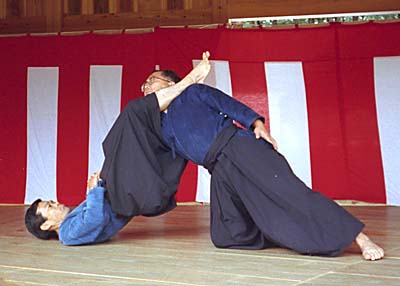
aqui podeis ver una imagen de yawara de tatsumi ryu, una escuela que formalmalmente es conocida por su iaijutsu (no no son japos haciendo bjj con falditas) para mas info sobre estas escuelas podeis visitar la pagina de donde he sacado la foto
koryu.com
Publicado: 24 Ago 2003 22:59
por P.P
Aunque considero mi opinión no tiene más interes que la de alguien que no ha entrenado nunca el Kendo,para mi es un Arte excepcional mirandolo desde el punto de vista del trabajo de percepción y reacción con respecto al ataque del adversario, es un arte en la que se buscan principios tan efectivos como no telegrafiar, velocidad, percepción,templanza...la pena es que no creo que sea muy conocido por aquí, corregidme si me equivoco, es un arte que no tengo muy claro donde lo enseñan aquí en España,pero es muy buen complemento...ya es otro tema el IAIDO...lo veo muy interesante, pero más limitado pues creo que su base es desenvainar la espada y atacar al mismo tiempo...como complemento lo veo un tanto más limitado, ¿como lo veis vosotros?
No estoy muy seguro pero creo que estos estilos, es decir el IAIDO, el KenDo y el Kenjutsu están un poco diferenciados en su práctica, si hy alguien que lo sepa, seguro que lo ewpone mejor que yo...Gracias.
Por cierto en una ocasión vi un documental de este arte y es increible con la edad que aun compiten los maestros de este estilo, es más el culman del video era un enfrentamioento entre dos maestros y todo el "asalto" se lo tiraron una frente al otro, observandose...lo curioso es que dado el momento pararon el combate y dieron a los dos por ganadores...cuando se quitaron las caretas eran dos ancianos empapados en sudor y jadeando, ya que había sido tal la tensión del momento buscando el timing con el que atacar que fueron merecedores de un empate, son cosas un poco esotéricas, pero reales y sin duda dignas al menos de tener en cuenta y respeto.De nuevo Gracias.